BLUETTI AC70 Reviews: See Why 0 Shoppers Rated It 0 Stars!
Before you toss it into your garage, read the 0 takes on the BLUETTI AC70. Is that 0/5 earned? Let’s find out.
 Supermod
  Moderator
 Recaptor
 BLUETTI AC70 Review: A Punchy, Portable Power Station That Makes “Small” Feel Big
The BLUETTI AC70 sits in that sweet middle ground for portable power: compact enough to toss in a car trunk, yet muscular enough to cover weekend camping, overnight outages, and quick job-site tasks. On paper, its feature mix reads like a greatest hits playlist—fast AC charging, solid LiFePO4 battery chemistry, app control, and a pure sine wave inverter. This review of the BLUETTI AC70 is based on the official specifications and available data, not hands-on testing, and aims to help you decide if its balance of size, speed, and safety aligns with your real-world use.
What matters most here? Capacity, output, recharge speed, and longevity. The AC70’s 768 Wh battery paired with a 1000 W inverter (and 1500 W surge) sets expectations for running essentials—small appliances, tools, and electronics—without lugging a giant power box. Add speedy top-ups and generous port selection, and you’ve got a power station that tries to be the “always ready” backup without the bulk tax.
Detailed Specs & Features
Let’s translate the spec sheet into everyday meaning. The headline is that LiFePO4 chemistry under the hood, which is known for stability and long service life. In this case, BLUETTI rates the pack for 3,000 cycles—a big deal if you plan to rely on the unit frequently. It also features a pure sine wave inverter with 2 AC outlets, giving you steady power for sensitive electronics. Power hungry laptop? No problem: the USB-C ports can deliver up to 100 W PD each, which is fast enough to juice modern notebooks without a separate brick.
Charging options are unusually flexible at this price/size. Plug it into the wall and you can push up to 950 W, refilling from empty in roughly 90 minutes—that’s “pack the car, top off the power station, and go” territory. Sun on your side? The MPPT controller supports up to 500 W solar input, making midday top-ups realistic if you pair it with panels. (It’s also got a built-in MPPT for better harvest efficiency.)
From a usability angle, the AC70 integrates Bluetooth app control for monitoring and toggling options remotely. There’s no Wi-Fi here, but for most outdoorsy and backup scenarios, local Bluetooth is often simpler and more reliable. And if you’re buying for peace of mind, the presence of an UPS/EPS function means it can step in as a basic power safeguard for a small workstation or modem/router during brief outages—handy for home office continuity.
User Experience & Performance (Based on Specs)
Design & Build
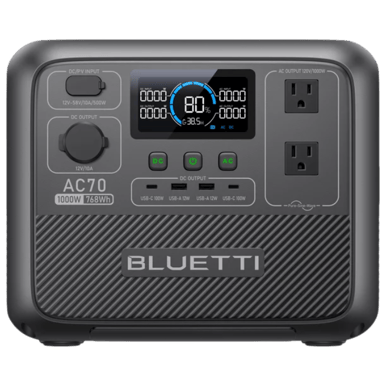
The AC70 is compact, with a sturdy, fixed carry handle and a boxy silhouette that favors stack-by-the-door practicality over showy flourishes. Its 22.5 lbs weight is manageable for most adults, especially given the 768 Wh capacity under the hood. You don’t get wheels or a telescopic handle, which keeps the footprint small but might matter if you’re hauling it longer distances. The plastic/ABS housing and matte finish help it shrug off fingerprints, while the LCD status display keeps the basics visible without diving into the app.
Performance
On paper, the AC70’s 1000 W continuous output comfortably covers laptops, camera batteries, lights, small kitchen appliances, and many power tools at moderate loads. The 1500 W surge offers a cushion for startup spikes—think small compressors or fridges—but sustained heavy draws will be limited by the 1000 W ceiling. With 768 Wh capacity, you’re looking at several hours of runtime for a 100–200 W workload and shorter bursts for power-hungry appliances. For emergency use, that’s enough to keep a router, a laptop, and a few lights online through a typical outage window.
The port mix is sensible: two AC outlets, a 12V car socket (120 W), dual USB-A for legacy gadgets, and two high-speed USB-C ports for modern gear. Notably absent are RV-centric or high-amp DC interfaces (no TT-30, no Anderson, no 24/48V DC), so if you’re a vanlifer who leans on those connections, you’ll want adapters or a different model. That being said, for mainstream users, this is a balanced, clutter-free setup.
Charging Behavior
The ability to accept up to 950 W max input via AC is a headline perk: you can grab a near-full charge while you pack the cooler. Solar at up to 500 W is well-matched to common 200–400 W panel kits; BLUETTI lists support for “2 × 200 W” panels, which is a practical sweet spot for car-camp setups. Car charging is supported too (longer at around nine hours), useful as a “top off while driving” plan.
Extra Features
App control via Bluetooth is increasingly table stakes, but still nice to have: check remaining capacity, toggle eco modes, initiate firmware updates, and peek at usage history. There’s also an eco mode and temperature protections managed by a BMS, and the unit includes basic weather-resistance claims (though no specific IP rating is given and it’s not water-resistant). Taken together, the safety stack is comprehensive for a consumer unit, with overcurrent, over-/under-voltage, and short-circuit protection on board.
Pros & Cons
Pros
- Fast wall recharging (up to 950 W) for ~90-minute top-ups.
- Durable LiFePO4 battery chemistry with 3,000-cycle rating.
- Strong port selection with dual 100 W USB-C for modern laptops.
- UPS/EPS function adds peace of mind for brief home outages.
- Compact and reasonably light for a 768 Wh class unit.
Cons
- No RV/van-specific DC ports (no TT-30, Anderson, or 24/48V DC).
- No Wi-Fi; app control is Bluetooth-only.
- Water resistance isn’t rated; keep it dry.
- Two AC sockets may feel limiting for multi-device setups.
Price & Value for Money
At the time of writing, the BLUETTI AC70 is listed for $329 at select retailers. For the feature set—LiFePO4 cells, 768 Wh capacity, 1000 W inverter, 500 W solar input, fast AC charging, and UPS/EPS—it’s a compelling value versus many competing 700–800 Wh models that either charge slower, skip app control, or use older chemistries. If your use case centers on short trips, home backup for a few essentials, or flexible “charge fast, use often” routines, the AC70’s spec mix punches above its price tag. You can check current pricing here: $329 at BluettiPower.com.
Who should buy it? Campers and road-trippers who prize quick top-offs and laptop-friendly USB-C power; homeowners wanting a neat UPS-style buffer for small electronics; and creators who run lights, cameras, and laptops on location. Who might skip it? Van/RV users who need TT-30 or Anderson by default, or buyers who frequently operate in wet environments and require a specific IP rating.
Quick Take
The BLUETTI AC70 blends fast AC charging, LiFePO4 longevity, and a sensible port layout into a compact 22.5-pound package. It’s designed to be easy to live with: charge it quickly, grab it when needed, and don’t sweat battery wear.
If you don’t need RV-specific ports or Wi-Fi, it’s a tidy, future-proof feeling pick for everyday backup and weekend adventure power.
Closing Recommendation
Based on the specifications and available data, the BLUETTI AC70 looks like a well-judged balance of capacity, output, and convenience at an approachable price. It favors practical speed (fast wall charging) and durable chemistry over flashy extras, which is exactly what many buyers actually need. If your checklist includes quick recharges, safe LiFePO4 cells, UPS/EPS capability, and strong USB-C support, the AC70 deserves a spot near the top of your shortlist.
Verdict
Rating: Based on the specifications and overall feature set, we believe BLUETTI AC70 deserves 4.5 out of 5.
- Winner Feature → Rapid AC recharging up to 950 W makes last-minute top-ups realistic.
- Needs Improvement → Lack of RV-centric DC ports and no water-resistance rating limit niche use cases.
Additional notes: According to its design, the AC70 also includes a 60-month warranty, which is unusually generous at this price; while we can’t validate service experiences here, the term itself adds confidence for long-term ownership.
Reviews 0
The good, the bad, and the brutally honest.Average Rating


More Portable Power Stations 427
Unlock more awesome finds.